






 Trap
 Normal
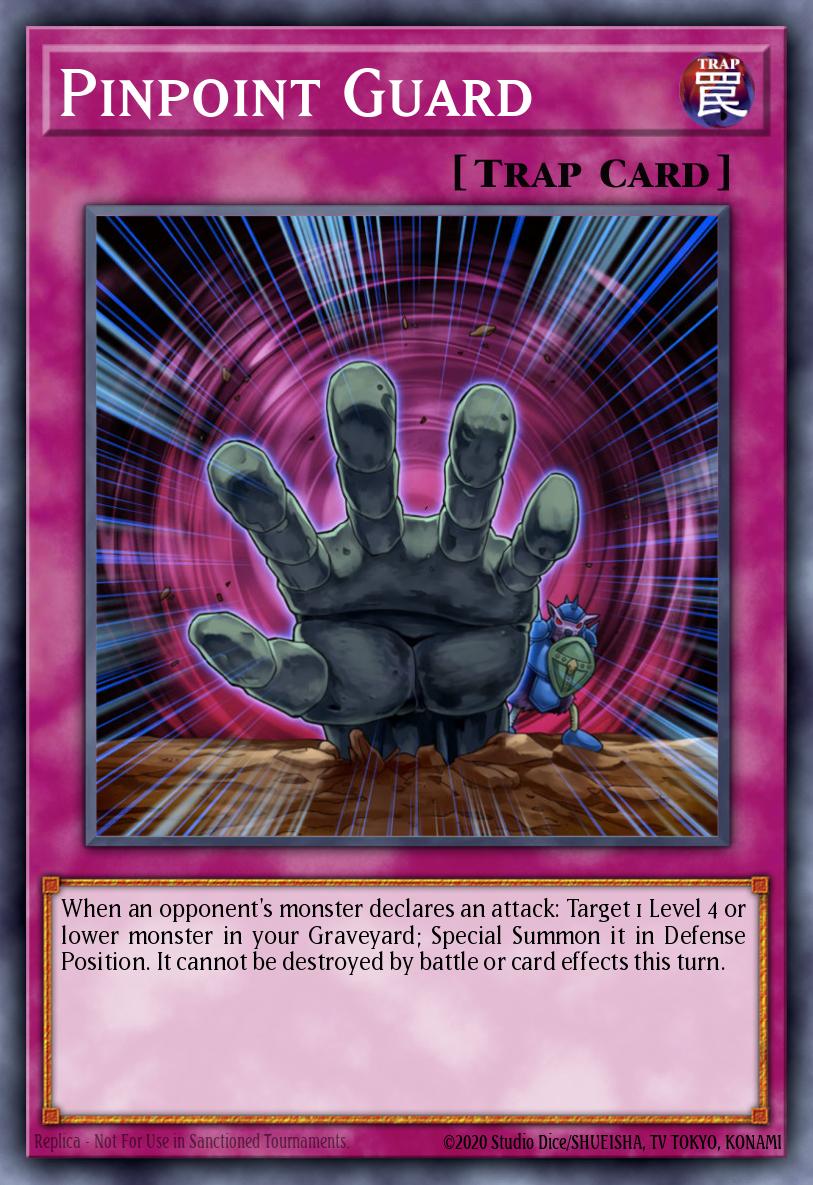
Pinpoint Guard
View:
3003
When an opponent's monster declares an attack: Target 1 Level 4 or lower monster in your Graveyard; Special Summon it in Defense Position. It cannot be destroyed by battle or card effects this turn.

Pinpoint Guard — Power Evaluation
Final Score: 40 ± 6 · Confidence: Medium
- Intrinsic: 43 · Deck: 42 · Meta: provisional
- Primary role: Recovery/Recursion · Secondary: Utility
Why it scores here
Pinpoint Guard is a reactive Normal Trap that recovers a Level 4 or lower monster from the GY when the opponent attacks, granting it one-turn indestructibility — a purely defensive payoff that never converts into proactive board advantage. Its score reflects genuine broad playability (64 decks, 41 distinct archetypes) concentrated in slower gameplay formats where grind-game traps have real value, but is held back by the twin constraints of requiring a set turn and a live attack declaration before it does anything. The revived monster enters Defense Position and receives protection for one turn only, so it rarely becomes a combo enabler; no combo evidence exists to contradict this assessment.
Axis scores
| Axis | Score | Evidence |
|---|---|---|
| Accessibility | 30 | Normal Trap must be set one turn before use, requires an opponent attack declaration to trigger, and needs a Level 4 or lower monster already in the GY — three chained conditions that substantially reduce how often it is live (verified from card text). |
| Combo & Conversion | 20 | Zero combo appearances in the evidence corpus; the revived monster enters Defense Position with no offensive follow-up implied by the card text, so combo conversion is entirely text-only inference (inferred). |
| Resource Economy | 45 | The card spends one trap slot to recover one GY monster for one turn, which is roughly card-neutral — no card draw, no additional plus, but no additional cost either (verified from card text). |
| Effect & Interaction | 25 | The trap does not negate attacks, does not negate effects, and does not remove opponent cards; it only grants indestructibility to the revived monster for one turn, providing soft defensive coverage rather than real disruption (verified from card text). |
| Material Utility | 35 | The revived monster enters in Defense Position and is protected this turn, usable as Synchro/Xyz/Link material if the rules allow a defense-position body — limited but not zero; 41 distinct archetypes suggest some decks value this body (observed from decks_evidence). |
| Resilience & Flexibility | 20 | As a face-down Normal Trap it is fully exposed to Harpie's Feather Duster (a top partner at 26.6% co-occurrence, confirming the format context) and other S/T removal; one negate stops it; its trigger window is narrow and cannot be used proactively (verified). |
| Deck-Building Efficiency | 65 | No archetype lock, no cost beyond the card slot, run in 41 distinct archetypes with ~1.83 avg copies — near-free-roll in slower formats; 31 of 64 decks run only 1 copy confirming low-commitment inclusion (observed from decks_evidence). |
Calculation
Weight profile: 0.7 Recovery/Recursion + 0.3 Utility. Intrinsic ≈ 43, Deck ≈ 42, Meta = provisional. Modifiers: Normal Trap vulnerability (-2). Final formula: 0.40*Intrinsic + 0.60*Deck
Strengths
- Exceptionally broad splashability — run in 41 distinct archetypes with no archetype restriction
- No activation cost beyond the card slot itself
- Provides one-turn indestructibility to the revived monster, surviving both battle and card effects
- Reliable fit in slower, grind-oriented formats where attack declarations are frequent
Weaknesses
- Normal Trap requires one full turn set before use — cannot be used the turn it is drawn
- Completely reactive — does nothing without an opponent attack declaration
- Restricted to Level 4 or lower GY targets, narrowing the pool in some strategies
- Revived monster enters Defense Position, limiting immediate offensive or Extra Deck follow-up
- Indestructibility lasts only the current turn — no permanent protection
Counters / choke points
- Spell/Trap removal before activation (Harpie's Feather Duster, Cosmic Cyclone, Twin Twisters)
- Effect negation on activation (Solemn Judgment, Dark Bribe, Seven Tools of the Bandit)
- Non-destruction removal on the revived monster (banishment, bounce, flip face-down) bypasses the indestructibility clause
- Win conditions that do not involve battle attacks bypass the trigger entirely (burn, deck-out)
Best use
Defensive recovery trap in slower grind-game formats; blocks an attack while retrieving a key Level 4 or lower body from the GY for follow-up. Decks: Egyptian God, Dark Magician, Blue-Eyes, Dragonmaid, Elemental HERO, Synchron. Suggested copies: 1.
Evidence & gaps
- Verified: Normal Trap Card — must be set one turn before activation; Trigger condition: opponent's monster declares an attack; Effect: target 1 Level 4 or lower monster in own GY; Special Summon in Defense Position; Revived monster cannot be destroyed by battle or card effects this turn only; Legal in TCG, OCG, and MasterDuel; limited to 1 copy in Duel Links
- Observed: Runs in 64 decks across 41 distinct archetypes — broad generic defensive usage; 73.4% of deck appearances are in gameplay type 7 (slower/traditional format context); Average 1.83 copies per deck; 31 of 64 decks run a single copy (low-commitment slot); Top partners are classic defensive staples: Mirror Force, Magic Cylinder, Fiendish Chain, Call of the Haunted; Harpie's Feather Duster co-occurs in 26.6% of its decks, confirming backrow-heavy format context
- Inferred: Primarily a defensive fill piece for slower formats — not a combo enabler or starter; Level 4 or lower GY requirement is non-restrictive in most strategies but does limit the target pool; One-turn indestructibility reduces the revived monster's long-term staying power significantly; Splashability across 41 archetypes confirms the generic defensive text reads broadly
- Data gaps: No combos supplied — combo conversion and material utility scored from text inference only No guides supplied — human context on practical role is absent No usage statistics (StatisticsCard) — archetype inclusion percentages are inferred from the 64-deck sample only Gameplay type IDs are numeric without labels — exact format context (e.g., Speed Duel, Traditional, Master Rule) cannot be confirmed